Why Mosquito Problems Spike in UAE Homes After the Summer — and What Actually Stops Them
Read Time:5 Minute, 15 Second
Most people in the UAE assume mosquitoes are a July problem. They are not. July is when everything is sealed shut and the air conditioning runs all day, which is roughly the worst month of the year for a mosquito trying to find you. The trouble starts when the weather breaks — late September through to about March — because that is when people open windows again, and when standing water sits around long enough to become a nursery.
If you have ever wondered why the bites start when the heat stops, that is why.
Where they actually breed, and it is closer than you think
Mosquitoes do not travel far. Most species stay within a few hundred metres of where they hatched, which means if you are being bitten in your flat, the water they came from is almost certainly on your own building or the plot next door.
In UAE buildings the usual suspects are the same every time:
The air conditioning condensate tray. A split unit pulls litres of water out of the air every day. If the drain is partially blocked — and in this climate they block constantly — that water pools in the tray. It is warm, it is still, and it is indoors. It is close to a perfect breeding site.
Balcony planters and their saucers. The plant does not need the saucer. The mosquito does.
Roof and podium drainage. Flat roofs and podium decks hold shallow water after a wash-down or a rare rain, and nobody inspects them.
Neighbouring construction plots. Any site with a water tank, an excavation, or stacked material that traps rainwater will produce mosquitoes for the entire street.
Fixing your own building’s water helps. It will not solve the problem, because you do not control the plot next door. That is why the physical barrier matters more here than the source control does.
The window you open is the one that decides it
This is where most homes lose. People fit screens on the windows they rarely open and leave the balcony door — the one that stands open every evening from October onwards — completely unscreened, because a door is harder to screen than a window and it usually costs more.
The result is a home that is 80% protected and 0% effective. A single unscreened opening that stays open for two hours a night undoes every screen in the flat.
If your budget only stretches so far, screen in this order: the door you actually use, then the bedroom windows, then everything else. Specialists like Mosquito Net Pro will measure the whole property free of charge and bring physical mesh samples, which is worth doing even if you only intend to screen one opening this year — you will at least know what the rest would cost, and screen sizes in UAE apartments are rarely standard.
Mesh grade is the decision most people get wrong
Almost everyone chooses a screen type first and never asks about the mesh. It is the wrong way round. The frame determines how the screen moves; the mesh determines whether it works.
Standard fibreglass is the default and it is fine for ordinary mosquitoes. It is cheap, it is easy to replace, and it will not stop anything smaller.
Fine or pollen mesh has a tighter weave. It stops sand flies and midges — the ones that get through standard mesh and leave you convinced the screen is faulty — and it cuts fine dust noticeably. The trade-off is airflow: a fine mesh reduces the breeze through the opening, which matters if you are screening precisely so you can stop using the AC in winter.
Pet-resistant mesh is a heavier polyester weave. If you have a cat, this is not optional. A cat will go through fibreglass in one afternoon and you will pay for the same screen twice.
Stainless steel is a different category — it is a security product that also keeps insects out. Expensive, and overkill for a fourth-floor apartment.
A reasonable rule: fibreglass for high floors with no pets, fine mesh for anyone near a construction site or with dust sensitivity, pet mesh for animals, steel only for ground floor and villa access points.
Matching the screen type to the opening
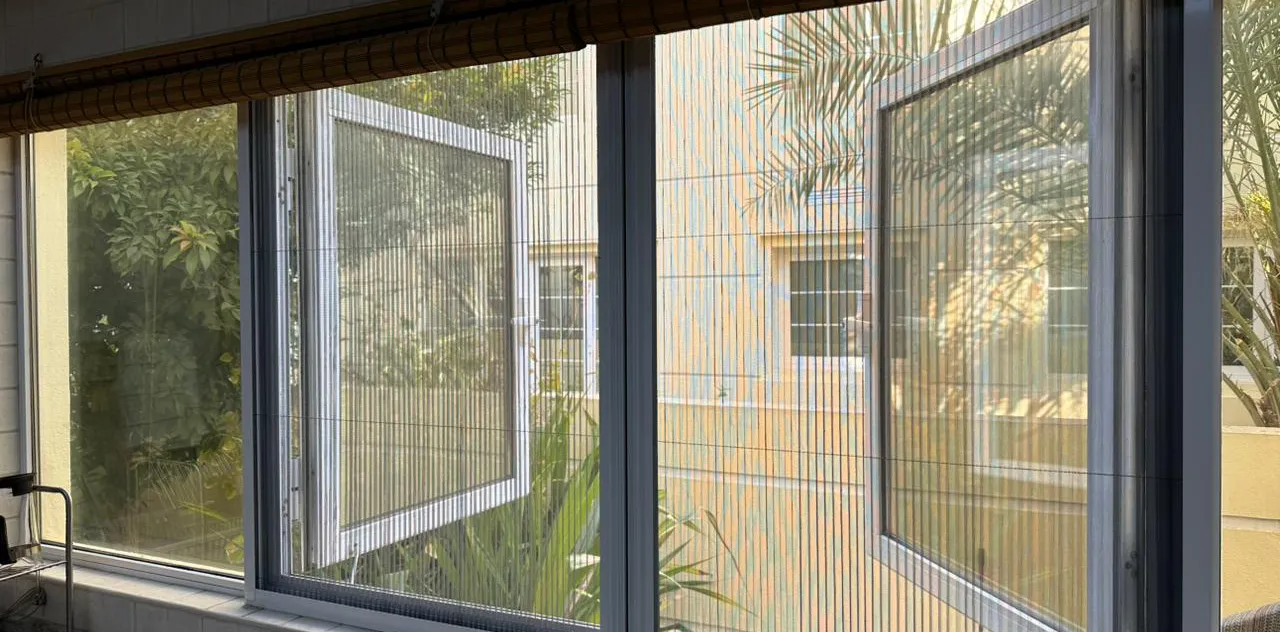
Pleated screens fold sideways like a concertina and suit wide openings and balcony doors. They handle spans that would sag on any other system.
Retractable screens roll into a cassette and disappear when not in use. Good where you do not want to look at a screen all year.
Sliding screens run on a track alongside a sliding window or door. Simple and durable.
Fixed screens are a frame fitted permanently into the opening. Cheapest per square metre, and the right answer for a window that only opens for ventilation.
Magnetic screens attach with a magnetic strip and can be removed without tools. Popular with tenants who cannot drill.
Motorised screens are a large-opening solution, usually for villas with wide glass runs.
Budget-wise, expect roughly AED 150 for a small window screen and up to AED 1,200 or more for a large or motorised opening. Anyone quoting a flat per-window price without measuring is guessing.
What is a waste of money
Plug-in repellents in a room with an open unscreened window. They cannot compete with a continuous supply of new arrivals.
Bug zappers on a balcony. They kill a great many insects and almost none of them are mosquitoes. Mosquitoes are drawn to carbon dioxide and body heat, not ultraviolet light.
Citronella candles outdoors in any breeze. The effective radius is smaller than most people’s balcony.
Cheap adhesive-tape screens. They fail in UAE heat. The adhesive softens, the mesh sags, and within a season you have a screen with a gap along the top edge — which is functionally no screen at all.
The one thing worth doing before the season turns
Flush your AC condensate drains and empty every planter saucer on the property. It takes an afternoon and it removes the breeding sites you actually control.
Then screen the door you use. Not the windows you do not open — the door you leave open every evening from October. That single opening is the difference between a home with a mosquito problem and one without.

Happy
0 %

Sad
0 %

Excited
0 %

Sleepy
0 %

Angry
0 %

Surprise
0 %
 0
0
 0
0